
Clean Move: The “Uber for Moving” Idea Taking Shape in Omaha
Jan 21, 2026If you’ve ever found a killer deal on Facebook Marketplace, stared at a couch that clearly doesn’t fit in your sedan, and thought “I’m not calling my buddy with the truck again,” you already understand the problem Clean Move is solving. In this Prairie Founders Club episode, Brian Lee sits down with Sloan Nelson, founder of Clean Move in Omaha, Nebraska, to unpack how a simple “micro-moving” pain turned into a tech-enabled service business with real momentum.

Executive summary
-
The wedge: Clean Move targets the gap between “too small for a traditional moving company” and “too big to DIY without a truck.”
-
The differentiator: Instant, self-serve pricing and booking through a website/app... no phone call required.
-
The model: Customers can choose vehicle size, add labor, pick a time slot, and prepay... reducing quoting chaos and operational friction.
-
The growth path: Word-of-mouth and social content beat paid search (for now).
-
The founder lesson: Build an MVP fast, ship it, and learn in public... Sloan’s “one hour a night” rule is a playbook for anyone with a day job.
The problem: “I need a truck… but only for one hour”
Clean Move exists because the moving industry has a weird dead zone. On one end you’ve got full-service movers built for big jobs. On the other end you’ve got DIY (and the informal economy of calling your uncle, bribing your friend with pizza, and praying nobody throws out their back). These are the moves that aren’t big enough to justify a traditional moving company, but still bigger than what most people can do alone, especially without a truck.
Clean Move solves that gap with a simple promise: show up with the right vehicle and the right help, quickly and predictably.
Sloan’s pitch is clean and specific: Clean Move offers micro moving, decluttering support, and junk hauling across the Omaha area (including surrounding communities). The goal is to help people simplify their life when they don’t have the vehicle or hands to get it done.
The services are intentionally practical:
-
Haul junk from basements/garages to disposal sites
-
Take usable items to donation centers like Goodwill or Habitat for Humanity
-
Deliver Marketplace purchases when neither buyer nor seller has the right vehicle
That Marketplace delivery angle is sneaky-good. It’s constant demand, high urgency, and a pain people feel immediately, without requiring a full “moving day” event.
Origin story: a travel nurse who moved every three months
Clean Move didn’t start from spreadsheets and market maps. It started from lived experience.
Sloan is a nurse by training and spent about three years travel nursing... relocating apartments every three months. That rhythm exposed a recurring pain: you don’t need a truck every day, but you do need one occasionally. And every time you need one, you either pay too much, wait too long, or ask for favors.
This is a classic founder advantage: she didn’t “discover” a market; she discovered a recurring frustration and built a solution that makes the hassle disappear.
The real moat isn’t the van—it’s the booking experience
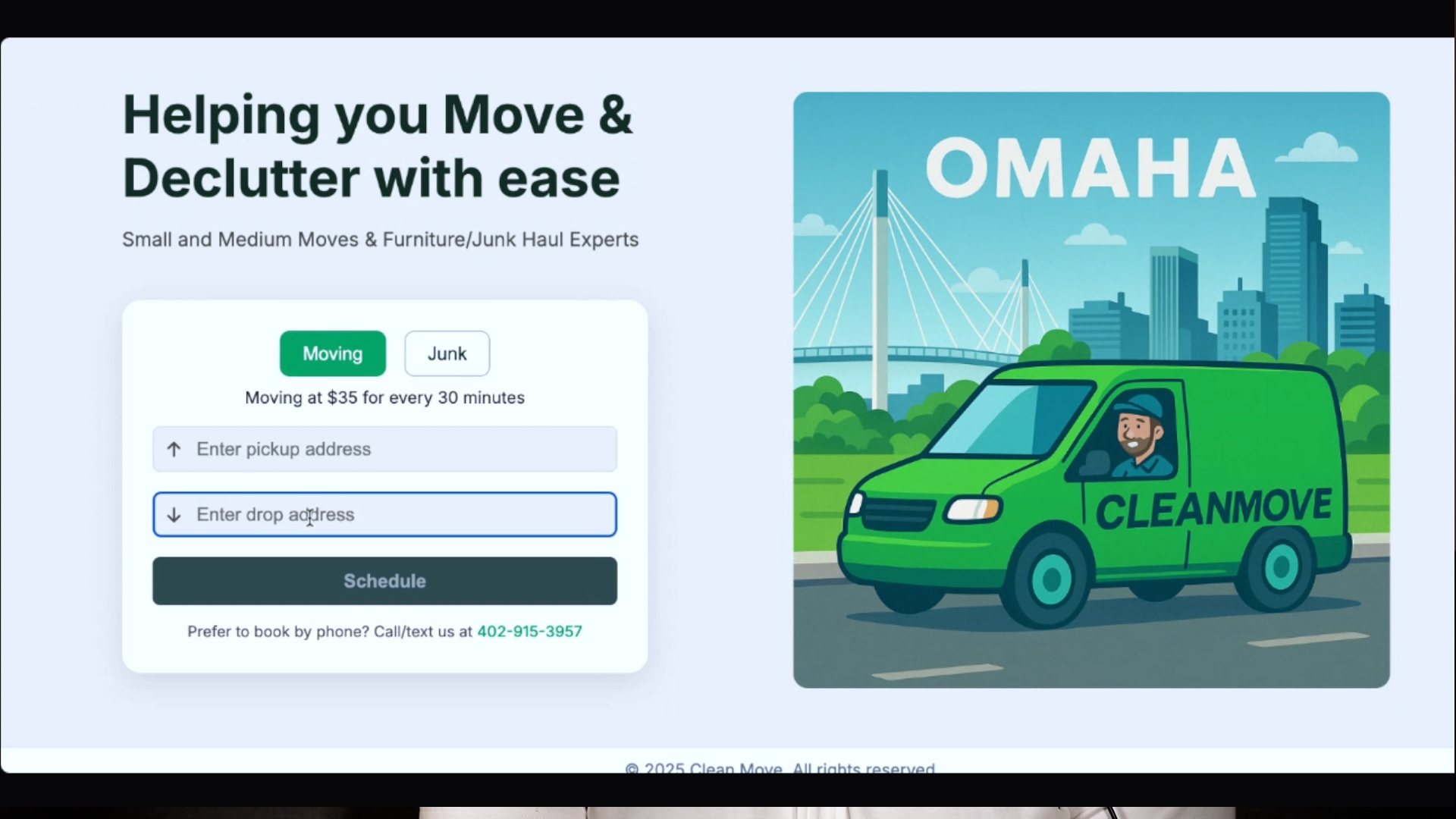
Most moving and junk-hauling businesses have similar capabilities: truck, labor, disposal, maybe some boxes. Clean Move’s bet is that the modern customer wants an experience that feels like ordering an Uber: tap, price, schedule, done.
A big issue in the moving/junk hauling world is that it often lacks modern technology, which creates two major customer problems:
-
It’s hard to book.
-
It’s hard to know what it will cost.
So Clean Move built a website/app that lets customers enter addresses and job type and get an instant, exact price—without a phone call and without entering a credit card just to explore options.
This matters more than it sounds. The invisible competitor is often “I’ll just do it myself,” especially for people who hate calling businesses. The frictionless interface isn’t a nice-to-have; it’s the product.
How the flow works: choose vehicle, add muscle, pick time, pay
The booking process is designed like a product, not a service quote:
A customer:
-
Goes to the site and chooses moving or junk
-
Enters pickup/drop-off (or pickup only for junk)
-
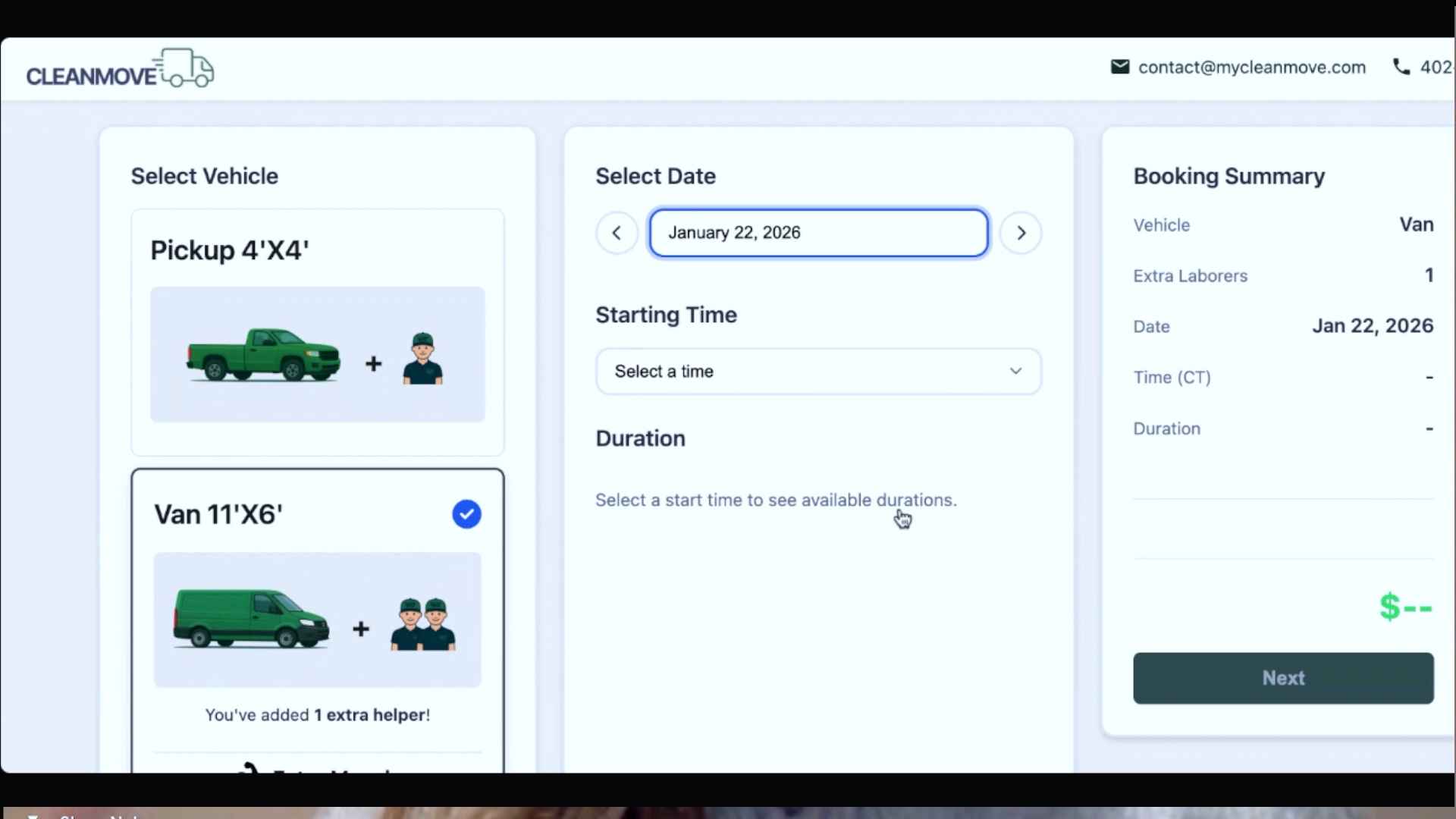
Selects a vehicle (pickup vs van vs larger moving truck)
-
Adds an extra laborer if needed
-
Picks a date/time slot
-
Gets an automated price based on vehicle + time duration + distance
-
Confirms and pays
Operationally, that flow does a lot of heavy lifting:
-
It reduces quoting time
-
It pre-qualifies customers (they’ve already accepted the pricing model)
-
It sets expectations (duration, labor, vehicle size)
-
It enables prepayment, which helps scheduling and cash flow
There’s also a pragmatic human layer: after booking, Sloan sometimes follows up to confirm details or ask for photos to ensure fit and supplies. But the system is designed to work even without that touch as the business scales.
Pricing strategy: start low, prove demand, then correct
Pricing is where a lot of new service businesses stall. Sloan took a smart early approach: be the most affordable option in the area and earn trust fast.
She compared the pricing experience to renting a U-Haul and pointed out a key advantage... Clean Move includes help, not just the vehicle. They started low to win customers and then increased prices once after realizing they were undercharging.
This is the right move for a local service with a tech twist: you want fast feedback loops and lots of reps. Once you have proof of demand and customers saying “wait, that’s it?” you’ve earned the right to adjust.
They also added tipping only after customers asked for it, and they don’t build tips into their financial model. That’s a healthy signal that the core pricing stands on its own.
Acquisition: word-of-mouth beats ads (especially early)
Clean Move’s early growth has been powered by referrals—friends telling friends, people texting about coworkers who might book soon, and customers spreading the word after a great experience.
They’ve also stayed active on Instagram and Facebook to keep local awareness high.
On the flip side, SEO and Google ads haven’t been their main engine yet. Early on, it’s hard to justify paid channels if the conversion path isn’t fully instrumented and seasonal demand swings are real (winter slowdowns are common in moving).
Here’s the bigger takeaway: referrals are the best early acquisition strategy because they validate that your service experience is actually great. Once you’ve nailed the delivery, you can scale awareness with more confidence.
Ops: keep it lean, track taxes, don’t over-tech too early
Even though Clean Move is “tech-enabled,” the back office stays intentionally simple.
They use Stripe for payments and keep internal tracking in Excel, including separating out estimated tax so they’re not surprised later. This is one of those underrated founder skills: knowing what not to add yet.
And the less glamorous reality is part of the story too: junk hauling means disposal sites, heavy lifting, and real labor. Sloan is still doing a lot of this work directly because the company isn’t at payroll scale yet. That’s what early-stage service entrepreneurship looks like.
Building the tech: fast MVP, strong network, ship and refine
If you’re listening and thinking “cool idea, but I could never build the app,” Sloan’s story should challenge that assumption.
She had friends and family in tech who put in hours after work, and she’s clear: without the technology, there is no Clean Move. They wanted something slick and easy because it’s the first impression, and the reason people remember them even when they don’t need a move today.
They built an MVP in roughly 2.5–3 months, launched it, and have been improving it based on real-world use ever since.
And it ties directly into the bigger vision: becoming an “Uber for moving”... open the app, book someone, they show up.
The founder advice that matters: “one hour a night” + don’t sit on the idea
For Prairie Founders Club listeners, especially those with full-time jobs, this is the part to replay.
Sloan’s recommendation is simple and actionable: allocate one hour after work every day to build, pitch the idea, and collect feedback. That hour often becomes two or three once momentum kicks in. The bigger message is: don’t wait. Build the product, put it out, and let customers teach you what to refine.
She’s also candid about the internal battle: committing money to a vehicle and monthly payments creates pressure. The hurdle isn’t just logistics, it’s confidence and staying committed through the “is this a terrible idea?” moments. The fact she pushed through that is part of why the business is real now.
Opportunities I see (if you’re building something similar)
A few leverage points jump out from this episode:
-
Instrument the funnel now.
If quote-to-book is truly high, you’ve got a conversion machine. The next bottleneck becomes traffic, and traffic gets a lot easier to buy when you know your numbers. -
Partnership flywheel.
The best partners are anyone who regularly encounters “small moves”: property managers, realtors, staging companies, senior living transition coordinators, donation centers, estate sale operators, and apartment communities. Referrals are already working; partnerships turn that into a repeatable system. -
Category expansion without losing focus.
Micro-moves + junk hauling + Marketplace delivery is already a strong triangle. You can expand with add-ons (packing help, donation drop-offs, light assembly/disassembly) without becoming “full-service movers.” -
Supply-side roadmap (the Uber step).
“Uber for moving” eventually implies a marketplace of vetted drivers/labor. That’s a different business than a single-operator service: bigger upside, but more complexity. The smart path is exactly what Clean Move is doing: lock the customer experience first, then scale operations.
Closing: Clean Move is winning by removing friction
This episode is a case study in modern service entrepreneurship: pick a painfully common problem, design the easiest possible customer journey, keep operations lean, and grow through trust and community.
Clean Move isn’t just “a moving company.” It’s a productized solution to those awkward, in-between jobs nobody else wants, wrapped in a booking experience that feels current, not outdated.
And for anyone sitting on an idea while working a 9-to-5, Sloan’s message is the one to take seriously: start small, build the MVP, and let real customers shape the rest.
The PFC Founder Starter Kit
(Value: $199 - Yours FREE)
-
The PFC Founder Blueprint Diagnostic: Your 10-minute "Pattern Recognition" tool to identify your Q1 Goals.
-
The 60-Minute Founder Clarity Masterclass: A deep dive into the Revenue 101 systems used by successful Midwest founders.
-
The Revenue Funnel Spreadsheet: A plug-and-play template to calculate LTV and predict your monthly income.
-
Free Guest Passes: Limited access to weekly live and on-demand member trainings.
-
The Vault Reading List: The essential books that form the foundation of the Prairie Founder Operating System.
-
Apply on the Job/Opportunity Board:
Search our internal Job and Gig board to find your next strategic partnership, job or opportunity.
Stay connected with news and updates!
Join our mailing list to receive the latest news and updates from our team.
Don't worry, your information will not be shared.
We hate SPAM. We will never sell your information, for any reason.